

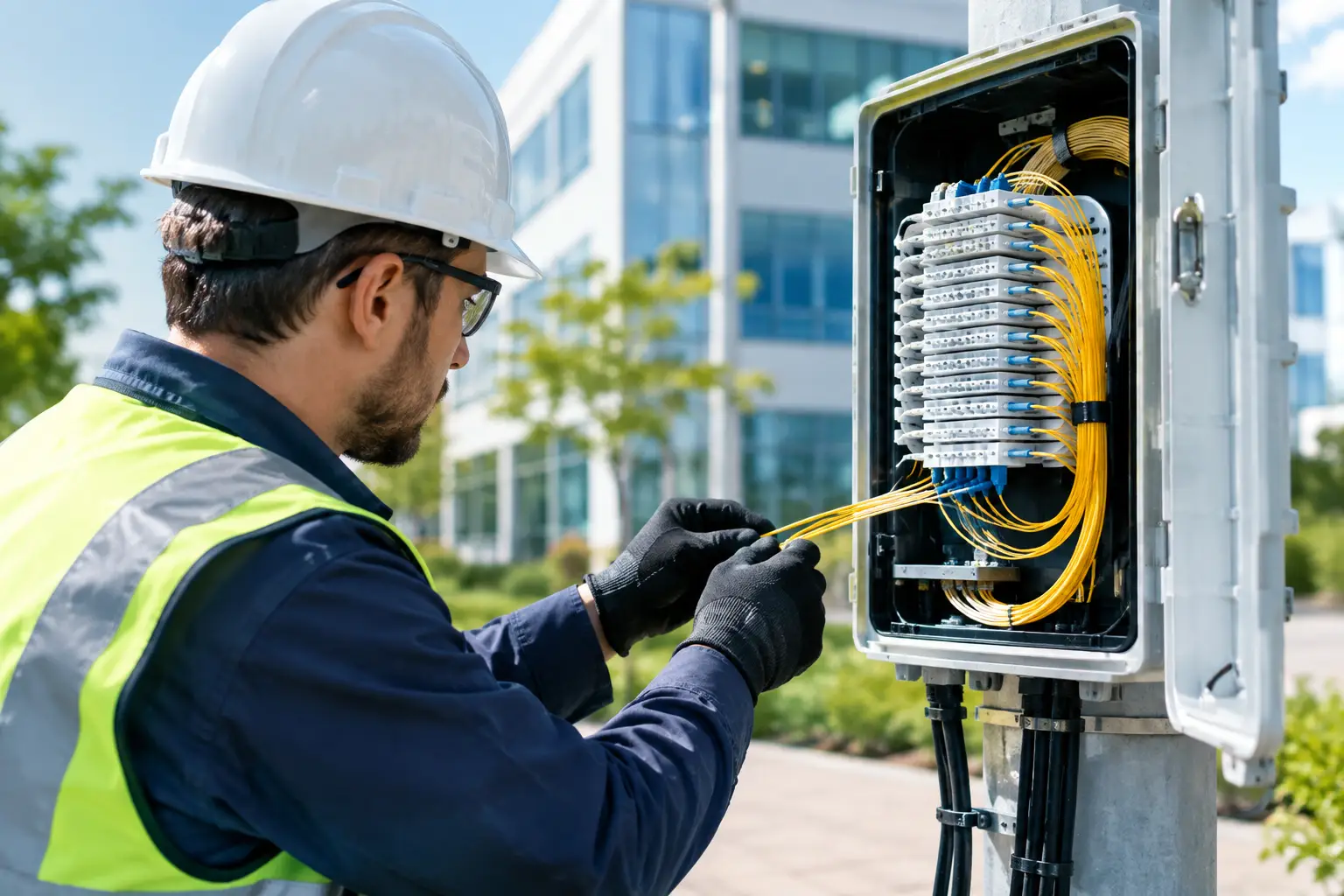
A search for commercial fiber deployment near me usually starts after a business has outgrown an unreliable connection, opened a new location, or discovered that its current bandwidth cannot support cloud applications, voice, security systems, and daily operations at once. The next step is not simply choosing the provider with the biggest advertised speed. It is confirming what service is actually available at your address and whether the installation plan supports how your business operates.
For organizations in West Palm Beach and throughout South Florida, fiber can be a major infrastructure upgrade. But availability, construction requirements, contract terms, and backup needs vary widely from one building to the next. A thoughtful evaluation protects your budget and helps prevent a frustrating deployment that takes longer or delivers less than expected.
What Commercial Fiber Deployment Really Means
Commercial fiber deployment is the process of bringing dedicated or business-grade fiber connectivity to a facility. In some cases, fiber is already lit in the building and service can be installed relatively quickly. In others, a provider must extend its network from the street, a nearby splice point, or another building before service can be activated.
That distinction matters. A provider may serve the surrounding neighborhood without having a ready connection inside your suite. An online availability check can be a useful starting point, but it is not the same as a formal site survey or serviceability review.
Fiber is often selected for its speed, capacity, and consistency. Unlike many shared broadband services, dedicated internet access can provide symmetrical upload and download speeds, defined service-level commitments, and a clearer path to adding capacity. That is valuable for businesses using hosted phone systems, video conferencing, cloud backups, large file transfers, remote access, and multiple connected locations.
Still, fiber is not automatically the right answer in every situation. A smaller office with limited application demands may be well served by a less expensive business broadband connection, especially if it has a reliable cellular backup. The right design depends on the cost of downtime, the number of users, the applications in use, and future growth plans.
How to Evaluate Commercial Fiber Deployment Near Me
The most useful question is not just, “Which carriers are nearby?” Ask, “Which providers can deliver the right service to this exact location on an acceptable timeline and budget?” A qualified telecom advisor or provider engineer should evaluate the physical address, suite location, building access, and nearby network infrastructure before making commitments.
Start with the business requirement
Before comparing providers, define what the connection needs to support. Consider the number of employees, peak internet use, cloud platforms, voice traffic, guest Wi-Fi, security cameras, and any applications that cannot tolerate interruptions.
Bandwidth is only one part of the decision. Latency, packet loss, uptime expectations, and response time when an issue occurs can be just as important. A medical office sending imaging files, a law firm working in cloud document platforms, and a warehouse using real-time inventory systems may all need fiber, but their priorities will not be identical.
It also helps to look ahead. If your team expects to add staff, open another office, move more systems to the cloud, or implement unified communications, selecting a connection that can scale may avoid a second installation project later.
Confirm the address, not just the ZIP code
Serviceability is highly specific. Two businesses on the same block may have very different options because of building construction, landlord requirements, conduit availability, or the proximity of the provider’s network.
A proper review should identify whether fiber is already in the building, whether construction is required, and whether the provider can install to your suite. If construction is needed, ask who is responsible for obtaining permits, coordinating access, and approving building entry. These details can shape both timeline and cost.
For multi-tenant properties, building management plays an important role. An existing agreement with a provider may simplify installation, but it may also limit options. Confirm whether your business can bring in another carrier if the current building provider does not meet your requirements.
Compare the complete service, not the headline speed
A 1 Gbps connection can mean very different things depending on the service type. Shared broadband, dedicated internet access, Ethernet transport, and managed SD-WAN connections are designed for different use cases. Comparing only the monthly rate or download speed can create expensive surprises.
Review the service-level agreement, installation interval, equipment responsibilities, contract term, early termination language, and escalation process. Ask whether the connection includes static IP addresses, how maintenance notifications are handled, and what happens if a circuit fails outside normal business hours.
Price matters, but so does the total cost of a poor decision. A lower monthly rate may not be the best value if the service has a long repair window, limited support, or no meaningful performance commitment.
Planning for Construction, Timing, and Costs
Fiber projects range from straightforward to complex. If a carrier already has fiber in the building and available capacity, installation may move quickly once contracts and building access are complete. If the network must be extended, the process can include engineering, permits, utility coordination, trenching, boring, or new pathway construction.
Construction does not necessarily mean the project is a bad fit. It may be the right investment for a facility that will support your business for years. The key is understanding the timeline before signing a lease, scheduling a move, or disconnecting an existing service.
One-time construction charges can vary significantly. In some situations, a provider may absorb part or all of the cost based on the contract term and expected revenue. In others, the business may need to contribute. Request clarity on whether charges are estimated or fixed, what work they cover, and what could cause the amount to change.
Do not overlook internal cabling either. Fiber delivered to the building entrance is not useful until it is extended to the network room and integrated with your firewall, switches, Wi-Fi, phone system, and backup connection. A complete deployment plan accounts for both the carrier circuit and the on-site network environment.
Build Resiliency Into the Design
Fiber improves reliability, but no single connection is immune to outages. A construction accident, equipment failure, power event, or network issue can still affect service. Businesses that depend heavily on connectivity should plan for continuity from the beginning.
The most effective backup is not always a second circuit from the same provider. True diversity may require a second carrier, a separate network path, or a wireless failover option. It depends on the risk level, facility layout, and how much downtime your organization can tolerate.
For many businesses, a fiber primary connection paired with managed cellular or fixed wireless backup offers a practical balance of performance and cost. Larger organizations may need diverse fiber entrances, automatic failover equipment, and monitoring that alerts the right people before an interruption affects customers.
Your phone system should be part of this conversation. If voice service is cloud-based, internet availability directly affects incoming and outgoing calls. A well-designed failover plan can route calls to mobile devices or alternate locations when the primary site loses connectivity.
Why Provider-Neutral Guidance Helps
Commercial fiber decisions often involve multiple carriers, each with different coverage maps, pricing structures, construction policies, and sales processes. Gathering quotes independently can consume considerable time, and it can be difficult to compare proposals that use different terminology and assumptions.
A provider-neutral advisor can help narrow the options based on your actual location and business goals rather than steering you toward one carrier’s offering. The value is not simply collecting prices. It is identifying serviceability, comparing like-for-like solutions, reviewing contract details, coordinating installation, and remaining available when support or renewal needs arise.
Peak Telecom works with businesses that need that kind of practical guidance, from evaluating internet access to coordinating voice, mobility, and network services around the connection. A single accountable point of contact can reduce vendor confusion when a deployment involves building management, an IT team, multiple carriers, and a move deadline.
Questions to Ask Before You Commit
Before authorizing a fiber order, make sure you can get clear answers to a few essential questions. Is the service already available in the building and suite? Is the quoted circuit dedicated or shared? What is the expected installation date, and what conditions could delay it? Are construction charges possible? What uptime commitment and repair targets apply? Finally, how will your business stay connected if the primary circuit goes down?
Those questions turn a broad local search into an informed infrastructure decision. The right fiber deployment should fit the way your business works now while giving you room to grow, dependable support when issues arise, and a plan for the day connectivity is tested.