

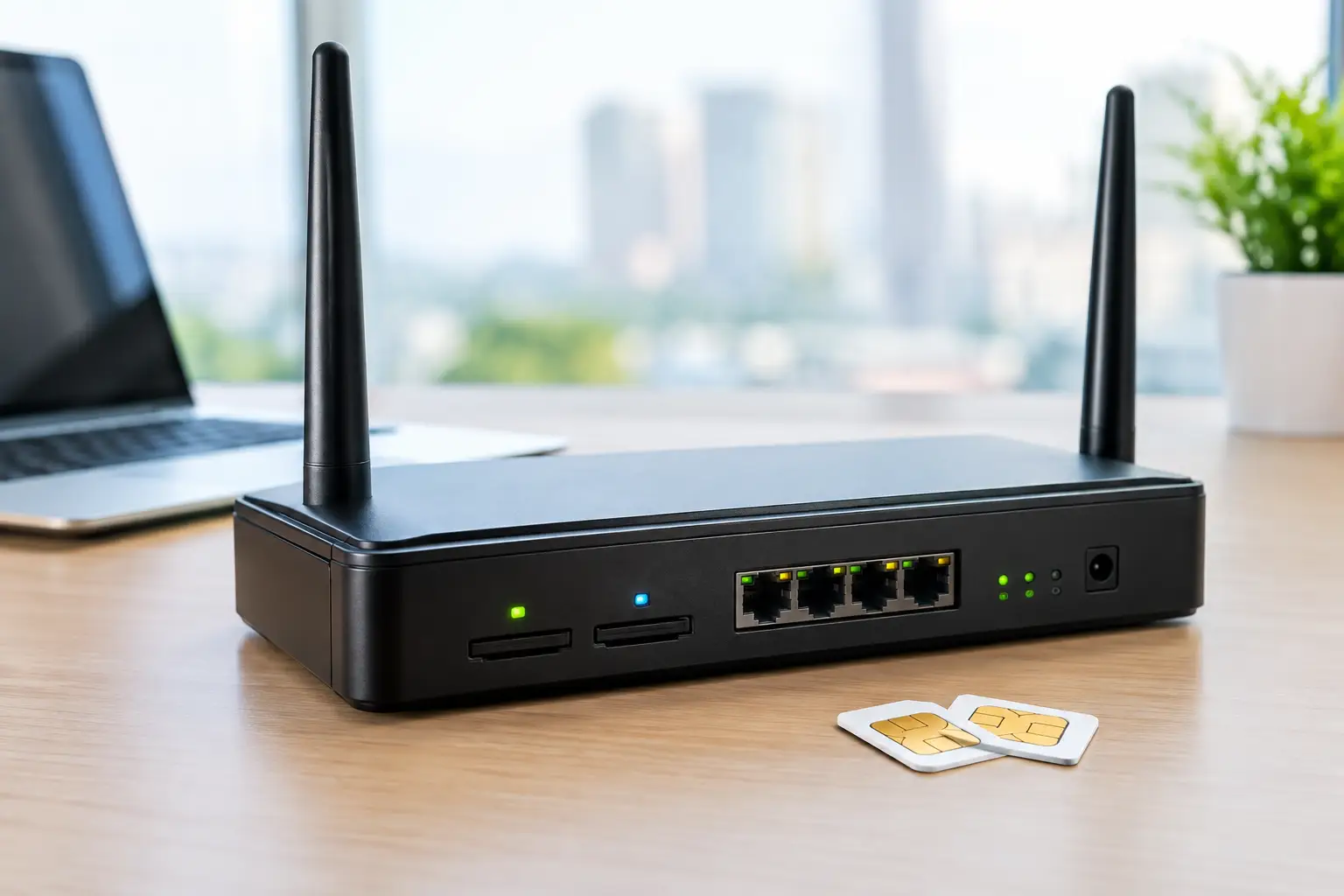
When a primary internet circuit goes down, a few minutes can interrupt payment processing, cloud applications, customer calls, security systems, and remote access. A dual sim active-passive failover gateway gives a business a secondary cellular path that takes over when the primary connection fails. It is a practical continuity tool, but only when the hardware, carrier coverage, data plan, and network configuration are chosen for the way your business actually operates.
For organizations that depend on always-available connectivity, the goal is not simply to add two SIM cards. The goal is to reduce downtime without creating another device that is difficult to manage, expensive to operate, or incapable of supporting essential traffic during an outage.
What Is a Dual SIM Active-Passive Failover Gateway?
A dual SIM gateway is a cellular networking device with two SIM slots. In an active-passive design, one cellular connection is designated as the primary wireless path and the second remains on standby. If the active SIM loses service, experiences poor performance, reaches a defined failure threshold, or cannot establish a data session, the gateway switches to the standby SIM.
This differs from an active-active configuration, where both SIMs may carry traffic at the same time. Active-passive failover prioritizes operational simplicity. One carrier is in use at a time, while the second provides an alternate path when conditions require it.
In many business deployments, the gateway itself serves as a backup to wired internet such as fiber, cable, or fixed wireless. The sequence is typically straightforward: the office uses its primary circuit under normal conditions; the router detects a failure; traffic moves to the cellular gateway; and the gateway can move between its preferred and backup SIM if necessary. This creates layers of protection rather than reliance on a single provider or access method.
Why Two SIMs Can Be Better Than One
A single cellular backup connection is helpful, but it can share risks that are easy to overlook. A local tower problem, maintenance event, congestion, or carrier outage may affect the only wireless service available to the site. A second SIM from a different carrier provides another option, especially in locations where signal strength varies by provider.
For South Florida businesses, carrier performance can change substantially from one building to the next. Concrete construction, low-e glass, equipment rooms, nearby construction, and weather can all affect indoor cellular service. A carrier that performs well outside may not deliver dependable service where the gateway is installed.
The second SIM also helps when the business has multiple locations with different coverage needs. One carrier may be the better default choice at a West Palm Beach office, while another may perform more consistently at a warehouse, clinic, construction site, or temporary location. The right design should be based on testing and business priorities, not a national coverage map alone.
There is a trade-off. Dual-SIM hardware does not guarantee instant, uninterrupted transition. The gateway needs time to recognize a failure, release or re-establish a cellular session, and route traffic through the alternate connection. Existing calls, VPN sessions, and application sessions may still drop. For most organizations, that brief disruption is far preferable to an extended loss of connectivity, but expectations should be set correctly.
Where Active-Passive Failover Fits Best
A dual SIM active-passive failover gateway is often a strong fit when cellular connectivity is needed primarily for backup, not as the main everyday transport. It can support a retail location that must process transactions, a professional office that needs access to cloud platforms, or a distributed business that cannot lose communications at an unattended site.
It can also be valuable for temporary and mobile operations. Job sites, pop-up locations, disaster recovery environments, event teams, and new offices waiting for a permanent circuit may need connectivity before wired service is available. In these cases, the cellular gateway may be the primary connection for a limited period, with one SIM acting as the preferred carrier and the other as protection.
The model is less suitable when the business expects both cellular connections to combine their bandwidth. Active-passive failover does not add the speed of two carriers together. If a location needs more consistent throughput or needs to distribute traffic across multiple links continuously, an active-active or SD-WAN design may be a better conversation.
What the Gateway Must Be Able to Do
Not all dual-SIM devices provide the same level of failover control. The gateway should be evaluated as part of the entire network, including the primary internet circuit, firewall, Wi-Fi environment, voice platform, and applications that must remain available.
Start with carrier compatibility. The device must support the cellular bands used by the intended carriers and should be certified or tested for those networks. 4G LTE may be sufficient for basic continuity requirements, while 5G can offer stronger capacity where coverage and plan terms support it. Faster cellular technology does not automatically mean better backup service if the signal is weak or the plan is restricted.
Failover detection is equally important. A device that only checks whether a cable is connected can miss a more common problem: the primary circuit is technically up, but the internet is unusable. Better configurations monitor reachable internet destinations and switch paths when those tests fail. Thresholds should be carefully set so a brief delay does not trigger needless failovers, while a true outage is recognized quickly.
Look closely at these operational capabilities:
- Support for two SIMs from separate carriers, with clear rules for preferred and standby service.
- External antenna options and proper antenna placement for buildings with weak indoor signal.
- Centralized monitoring, alerts, and remote management for IT teams or managed service partners.
- Security features that fit the existing firewall and network design, including VPN support where required.
- Traffic controls that prioritize essential applications and limit unnecessary data use during an outage.
A gateway should also preserve the network experience as much as possible. If staff members must manually reconnect to Wi-Fi, change application settings, or use a different process to reach cloud tools, the backup design has not fully done its job.
Data Planning Is Part of the Design
Cellular backup can become expensive when the data plan is treated as an afterthought. During a multi-hour outage, automatic software updates, video streaming, cloud backups, and guest Wi-Fi can consume far more data than critical business activity.
Before selecting a plan, identify what must work during an outage. For some businesses, that means point-of-sale terminals, a few cloud applications, essential email, voice traffic, and remote support. For others, it includes cameras, large file transfers, or a full staff working from cloud-based systems. Those scenarios have very different data requirements.
A thoughtful configuration may block guest access, defer updates, restrict nonessential traffic, and apply quality-of-service rules while operating on cellular backup. It should also provide usage reporting and alerts before data thresholds are exceeded. Unlimited plans can still have network-management policies, deprioritization, or usage limits that affect performance, so the contract details matter.
Test the Failover Before You Need It
A backup connection that has never been tested is an assumption, not a continuity plan. Schedule testing after installation and at regular intervals. Confirm that the primary circuit fails over as expected, that the preferred SIM establishes service, and that the standby SIM can take over when needed.
Testing should include the applications that matter most. Can the point-of-sale system process a transaction? Can users access the business phone platform? Can a remote employee reach essential files? Can the security provider communicate? A successful speed test alone does not answer these questions.
Document who receives outage alerts, who can approve additional data if an event lasts longer than expected, and who contacts the carrier or technology provider when there is a problem. Clear ownership turns failover from a piece of hardware into a reliable operating process.
Choosing a Design That Matches the Business
The best dual SIM active-passive failover gateway design depends on the location, the existing network, the applications in use, and the cost of downtime. A small office may need a straightforward cellular backup with basic traffic restrictions. A multi-site organization may need standardized equipment, monitoring across every location, coordinated carrier plans, and a documented response process.
This is where provider-neutral guidance can save time. Rather than selecting equipment and cellular service in isolation, Peak Telecom helps businesses evaluate the available carrier options, coverage conditions, network requirements, and ongoing support responsibilities as one connected decision.
A failover plan should give your team confidence without asking them to become cellular-network specialists. Start with the business functions that cannot stop, test the available carriers at the site, and build the backup path around those real requirements. When the primary circuit has a bad day, your customers and employees should notice as little as possible.